What a knowledge panel actually is
A knowledge panel is the box Google draws to the right of the results when it is confident enough about who or what you are to answer directly rather than simply list pages that mention you. On a phone it sits above the results rather than beside them.
The important word in that sentence is confident. A panel is not a reward for being important, it is not something you apply for, and there is no form. It appears when Google believes it knows who you are, and it weakens or disappears when that belief does. We have watched both happen to the same person.
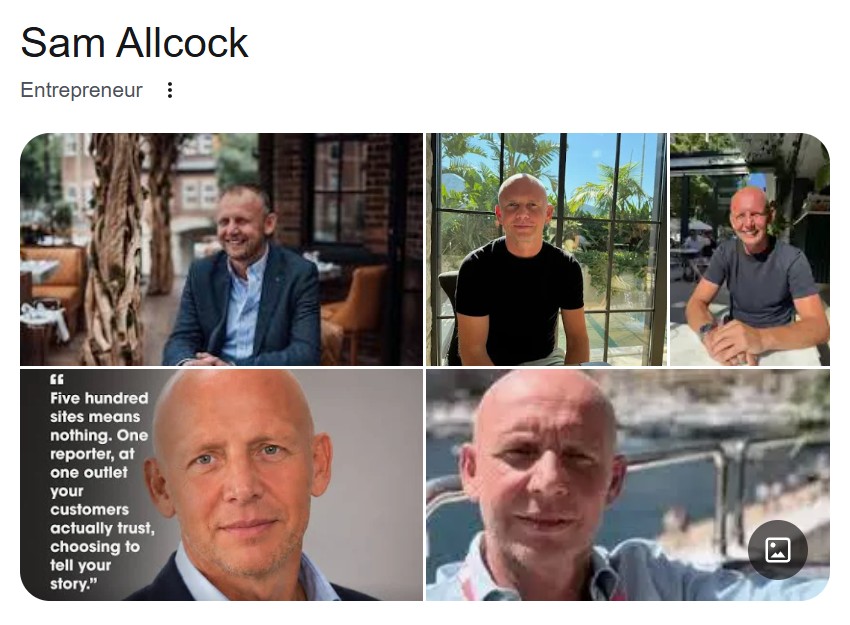
What a panel does for you is simple and quite hard to get any other way. It answers the question before anybody reads a single result. Somebody checking you before a call sees a box that says who you are, what you do and what you are known for, rather than ten links they have to interpret.
Where the facts inside it come from
Not from your website, mostly. This is the part that surprises people and it is the part that decides what work is worth doing.
A panel is drawn from what Google holds about you as a thing in the world, rather than as a page. That store is assembled from sources it already trusts to be about people and organisations: open databases, your own profiles where they agree with one another, public registers, and published coverage. Your own site contributes, but mostly as backup for what the other sources say rather than as the source itself.
We can show the mechanism directly rather than describe it. Our founder's panel states a date of birth. That date appears on exactly one source on the open web, an open wiki entry we placed ourselves. No news article carries it. His own site did not carry the full date until this week. And Google prints it anyway.
A date on one source, repeated by Google. That is ingestion, photographed, rather than a theory about how it works.
That is worth sitting with, because it cuts against the usual advice. The fact did not need to be widely reported. It needed to exist once, in a form a machine could read, somewhere that Google already trusts for facts of that kind.
What actually produces one, and what does not
The common advice is press coverage: get written about enough and a panel follows. On the evidence we hold, coverage volume is close to irrelevant to whether a panel appears.
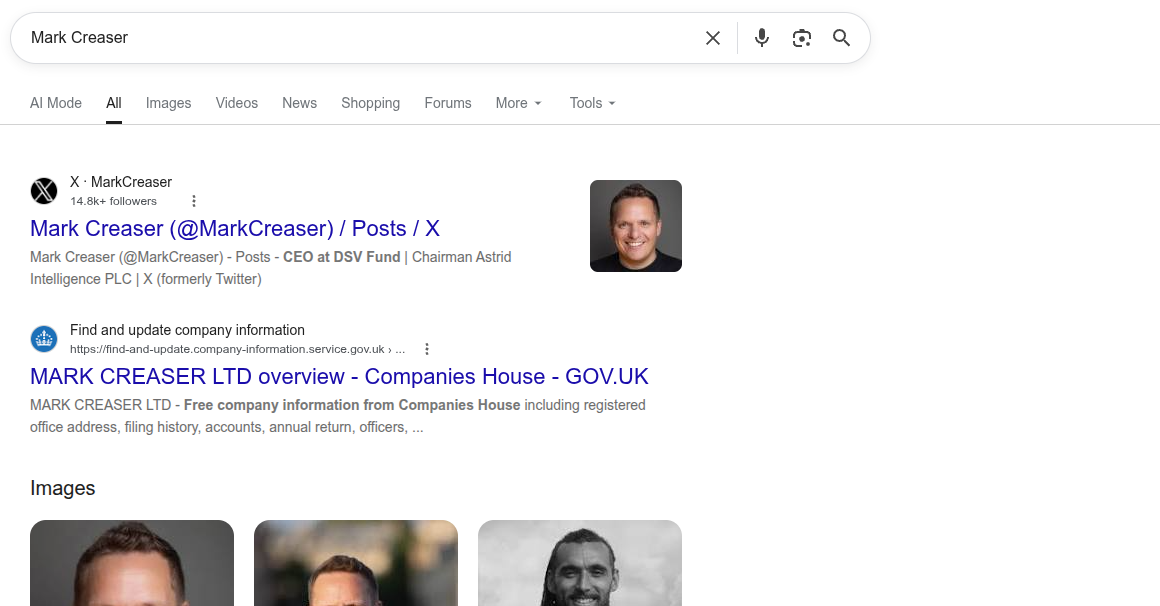
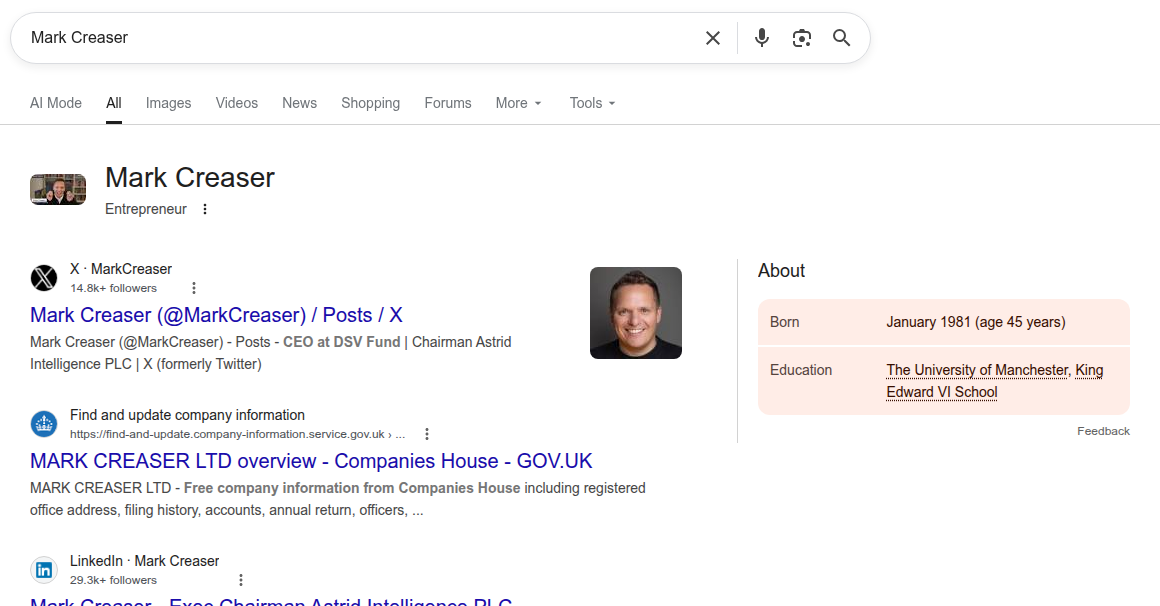
Mark Creaser went from no record at all to a knowledge panel in eleven days. In that window no press was placed and no links were bought. What changed was three things, all of them about making existing true facts legible and consistent.
What was done, in full:
- A sourced record in an open database, every statement carrying a real reference that already existed.
- A page of his own carrying the hidden labels that tell a search engine this page is about a person, here is his name, here is his job.
- His job title made to agree on every profile he owns, exactly, word for word.
This is not an argument against coverage, and it would be a mistake to read it that way. Coverage is what makes a record hold once it exists, and it is what fills the description line. A record with nothing published behind it is thin, and a thin record is the one that gets challenged.
They are two different jobs. Most writing on this subject runs them together, and a client who believes coverage produces the panel will spend a great deal of money in the wrong order. If you have nothing published at all, a placement comes first and it is a prerequisite rather than an upsell.
The part most guides leave out
Eleven days is the fastest result we have recorded and it is the one we are allowed to name. What happened afterwards belongs on the same page.
The record we created for Mark Creaser was nominated at a notability review on 22 August 2026 and deleted three days later, along with nineteen others created by the same account. Across two subjects we have had four records created and all four deleted.
Four created, four deleted. We publish that because a guide written by somebody it never happened to is worth less.
That is the single most useful thing we know about this subject and almost nobody writes it down, because agencies do not publish their failures. The bar is real, it is enforced by people rather than by an algorithm, and it is applied retrospectively. A record that stood for a fortnight is not a record that will stand.
The practical consequence is that the database step is the only one where failing costs you something you cannot get back. A deleted record is worse than never having had one, because the deletion is itself a durable public record and the next attempt is read in its light. We go through what that actually taught us on the case study.
What we will not tell you
Nobody controls when Google draws a panel, and we would not believe anybody who said they did. What we do is aim for one and put money behind the aim: the monthly fee does not begin until a panel has appeared for your name, and if one never appears it is never charged.
A complete set of correct records is also not the same thing as a panel. We have seen records that are right in every respect produce nothing, and we have seen a panel appear in under a fortnight. Anybody offering you a percentage likelihood is making it up, and we will not put a number on it either.
We will also not tell you that a panel is permanent. The underlying record can be challenged, your title can change, and the sources that supported a fact can go offline. That is why the work has a monthly half rather than being a single delivery.
Checking whether you have one, properly
Search your own name while signed out, on a phone and on a desktop, and in the country you actually care about. A panel can be visible in one and not in another, and a signed-in view is not the view a stranger gets.
Do not trust an automated checking tool for this, including anything we build. We proved this twice on our own founder, on captures taken five days apart and rendered at four screen widths.
In both captures the name appeared 86 times in the underlying page and was drawn only in the ordinary results on the left. The panel header, the subtitle and the photograph mosaic were never painted at all. The data was all there. The code that draws it runs in a browser and does not run in an offline capture.
So a tool reporting no panel may be right, or it may be structurally unable to see one. Those are different answers and they must not be collapsed into each other. We go through the measurement in full, because it decides money for us: our guarantee turns on whether a panel appeared.
The one thing worth doing first
Make your job title the same everywhere. Not similar. The same words in the same order, on your own site, on every profile you own, and on any register you appear on.
It is free, it takes an evening, and it is the single input we have seen move most often. Saying so costs us nothing, and it is how you can tell which of the other steps are genuinely hard. If somebody tells you that step is difficult, they are selling you something.
After that, the order is: a page you control, a sourced record, something published to point at. The full sequence is here, with the free steps named as free.
And before any of it, find out what is actually there. Most people have never looked properly. Measured across every audit we ran this year, twenty of twenty one people owned less than a fifth of the first page of results for their own name, and more than a few of them were looking at a stranger.
Mark Creaser, no record to a knowledge panel in eleven days, baseline captured 13 August 2026 and the panel captured 14 August 2026. No press placed in that window and no links bought.