What was there at the start
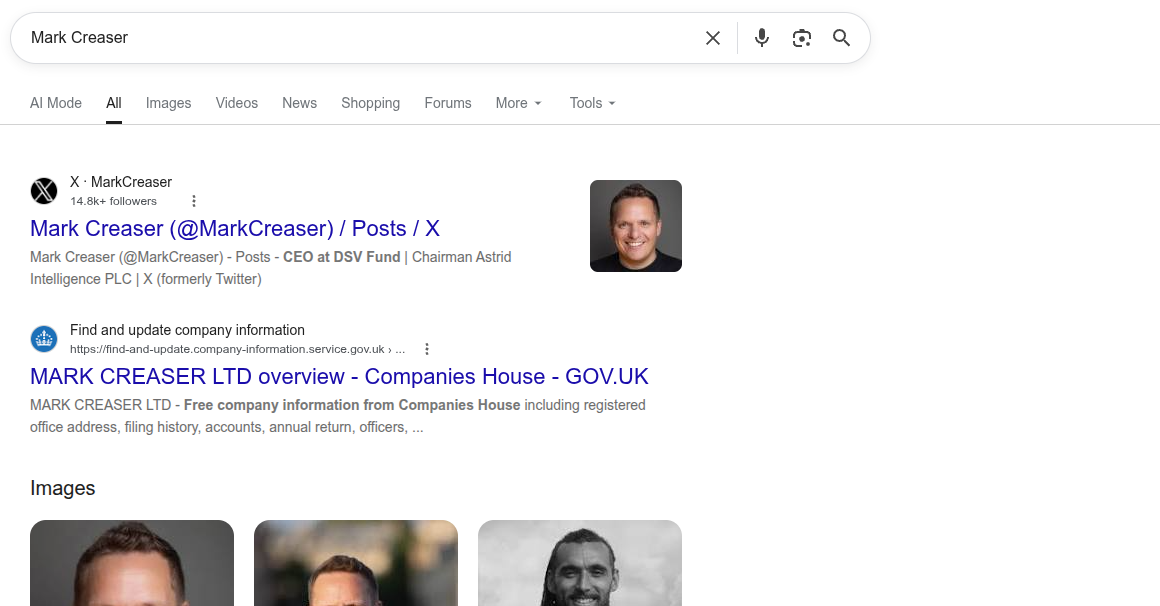
Nothing. No record in any open database, no page of his own carrying the labels, and no agreement between his profiles about what his job actually was.
A baseline capture was taken and dated before any work began. That is the only reason this page can claim anything at all, and it is the step most case studies skip.
What was done
A sourced record in an open database, with every statement carrying a real reference that already existed. A hosted page at his own name with the hidden labels and a list of his other profiles, pointing both ways so each record names the other. His job title brought into line everywhere it appeared.
No press was placed. No links were bought. The whole intervention was making a set of existing true facts legible and consistent with each other. The general sequence is here.
What appeared
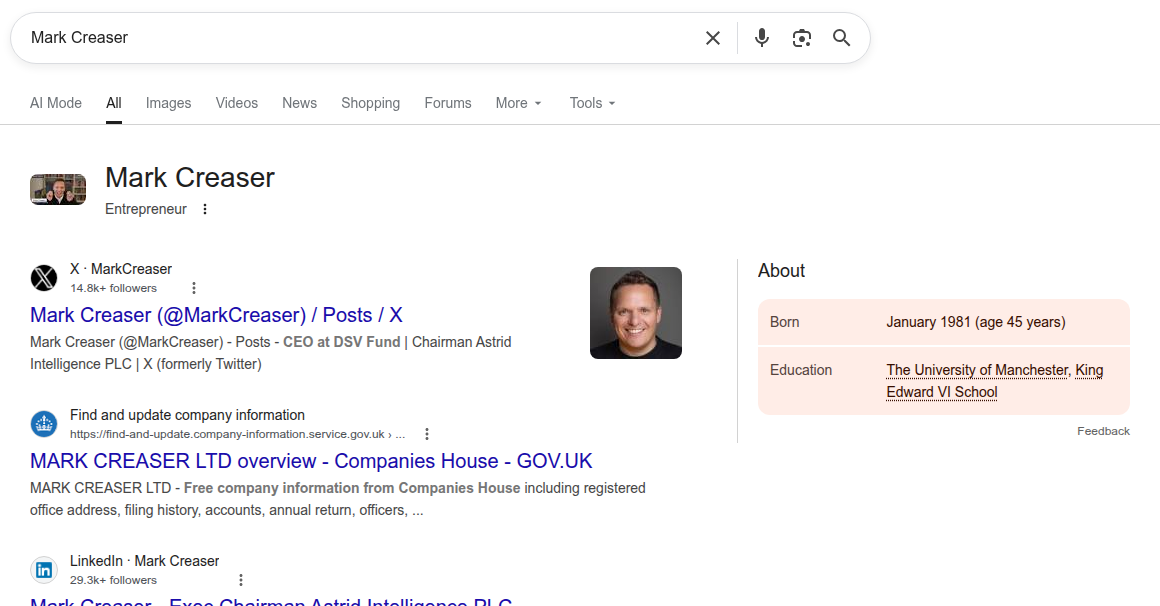
The About card showed facts that existed in a form a machine could read in exactly one place: the record we had created. That is the attribution argument and it is the strongest part of this case.
The photograph was wrong. Google chose a still from a video, because the record carried no image property at all. That detail is here because it is precisely the sort of thing a case study tidies away, and it has a specific cause and a specific fix.
And what happened next
On 22 August 2026 a bulk deletion request was filed against twenty records created by the same account, his among them. On 25 August they were all deleted. Across two subjects we have now had four records created and all four deleted at review.
We publish this because leaving it out would make the page a fabrication, and because it is more useful than the success.
What it teaches is specific. The bar is enforced by people, not by an algorithm. It is applied retrospectively, so a record standing for a fortnight tells you nothing. Records whose only real source is a registry entry are the ones that get nominated. And a deleted record is worse than none, because the deletion is itself durable and the next attempt is read in its light.
It is why we treat the database step as the one place where failing costs something, and why we would rather tell somebody their sourcing is too thin than take the money and try.
What is still true
The eleven days happened, the captures are dated, and the mechanism they demonstrate is real: identity consistency plus a sourced record produced a panel with no press behind it.
What the deletion changed is the durability, not the mechanism. It is the difference between knowing how something works and knowing how to make it last, and the second is the harder half.
Baseline captured 13 August 2026 with no panel present. Panel present in the capture of 14 August 2026. Eleven days from the start of work. The underlying record was deleted at review on 25 August 2026.