A person is usually easier than a company
People have dates of birth, places, roles and employers. Those are exactly the kinds of facts the systems behind a panel are built to hold, and they join to other records cleanly. A date of birth is unambiguous in a way a company's trading name is not.
Companies have names that collide with ordinary language, registered addresses shared with their accountant, and trading names that differ from the registered one. Our own company is a good example and a humbling one.
An automated listings check reported Domain Farm present on nine of sixteen platforms, which would have been a strong result. Reading the titles, not one hit was the company. Every one of them merely contained the words domain and farm: agricultural technology profiles, privacy notices, a terms page.
A tally is not evidence until somebody reads the titles. A company called two common nouns has a problem no amount of work removes.
Unless you share your name
Every audit we run turns this up, and it is the single most universal finding in the business.
From real reports this year:
- One client shares a name with a footballer who died in 1970.
- Another with a man executed in Texas, whose result sat second.
- Another with the wife of a musician, who supplies two of the three images Google shows.
- Another with a nineteenth century bushranger, shot by police aged twenty seven, who holds the panel.
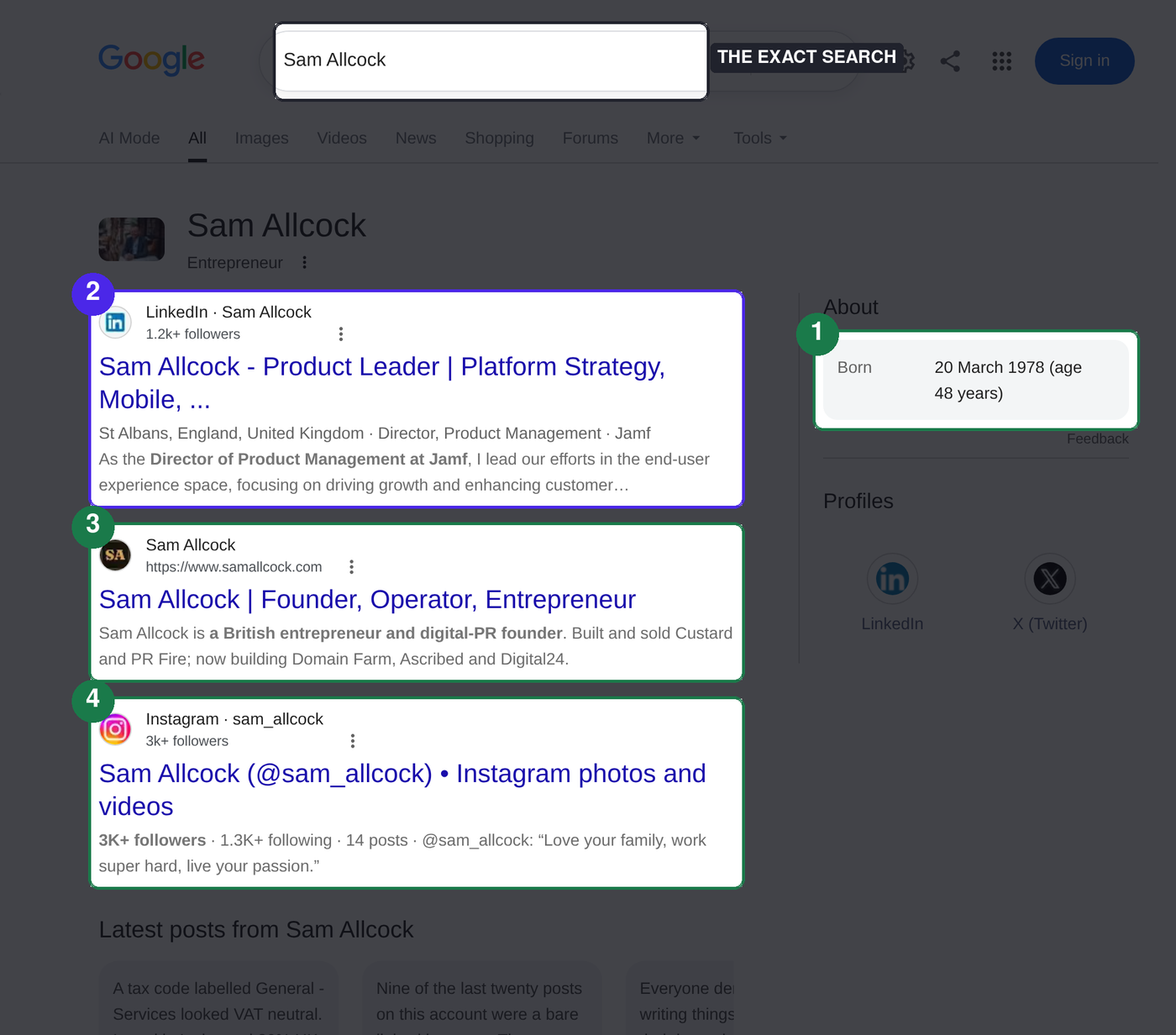
A panel that fires for your name is not automatically your panel, and this is the most dangerous mistake available in this field. We found six of twenty one clients with a panel showing. Every one belonged to somebody else.
Telling a client they already have a panel on the strength of a stranger's is the most damaging statement this product could make. It is why our own tooling will not report a panel as yours without something actually joining the two records, and why the state it reports is present but unattributed rather than present.
Why a dull distinctive name beats a famous shared one
If your name is close to unique, the hardest part is already done. If you share it with somebody better documented, the work is separating you from them, and that is a different and considerably longer job.
It is also why the first thing we show anybody is the other people who come up for their name. A client suggested it and he was right that it is universal rather than personal. Showing somebody the four strangers above them makes the argument for having a record of their own better than any sales page.
Where one of those results is grave, it stays out of the written document and is handled by telephone. That is a standing rule and it has no exceptions.
What this means for the work
On a distinctive name, the job is mostly the ordinary sequence done properly.
On a shared name it is that plus separation: making every attribute that distinguishes you from your namesakes explicit and consistent, so there is something to tell you apart by. Your employer, your town, your company number, your date of birth.
And occasionally the honest answer is the opposite job entirely. Two people in one week told us they wanted to be harder to find rather than easier, which is a coherent strategy and one we also do. Strengthening the record of somebody trying to disappear makes their situation worse, not better.
Six of twenty one audited clients showed a panel for their name. Every single one belonged to somebody else, including a correspondent at an American news network and a law professor who died in 1943.