Before the five steps: look at what is there
Almost nobody has done this properly. Type your name, signed out, and read all ten results rather than the first three. Then do it again with your name plus your company, and your name plus your job.
Use the search a real person would type, not the one that flatters you. We learned that the expensive way. One client's report was built on his own LinkedIn phrasing, a string nobody would ever type. Running the search a real person would use surfaced a different man with the same name, a CBE in the same professional territory, sitting directly below our client. The flattering search had hidden a rival, understated the client and overstated his position, all at once.
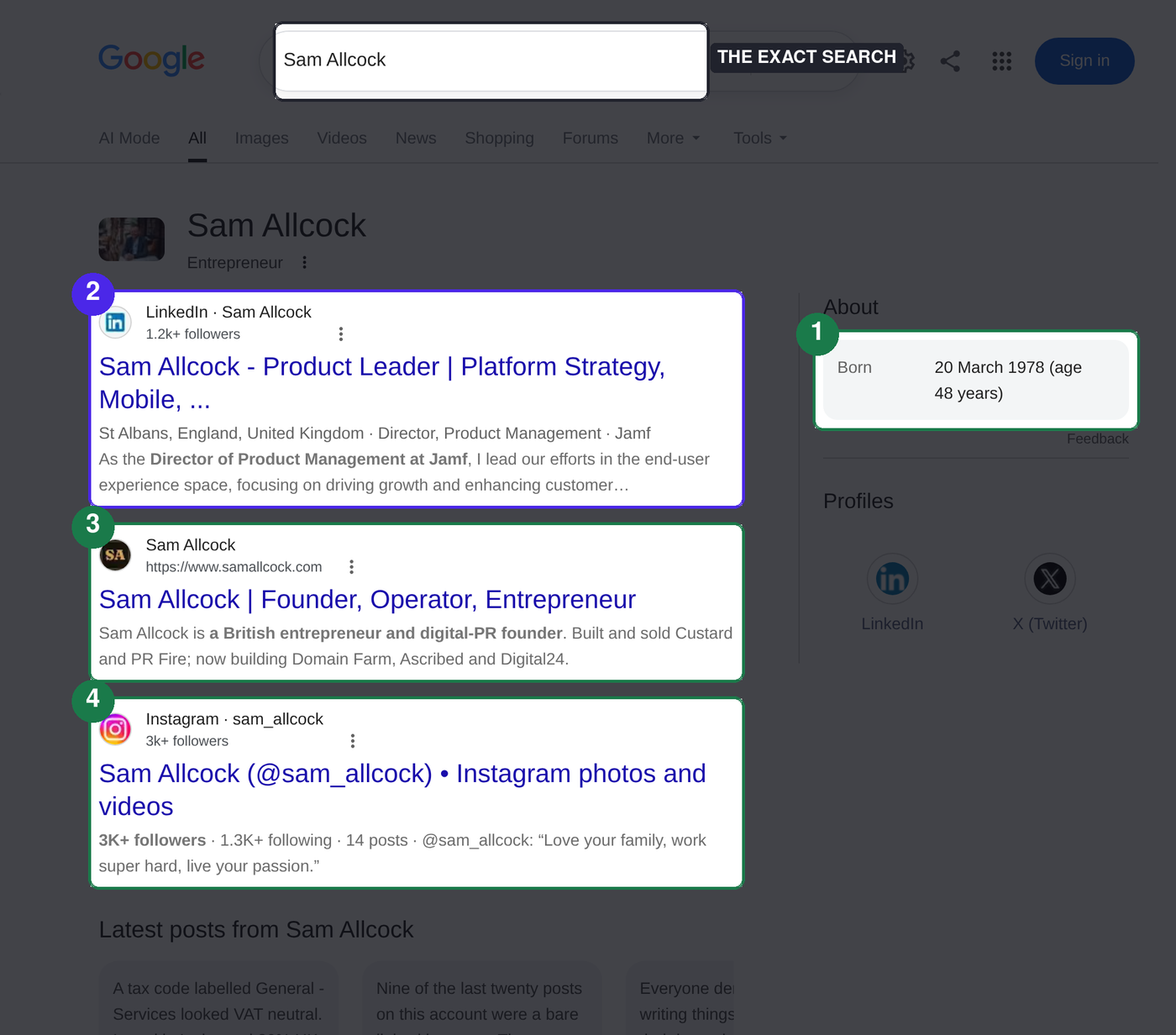
One. A page you control that says who you are
Not a profile on somebody else's platform. A page at an address you own, carrying the hidden labels that tell a search engine this page is about a person, here is her name, here is her job, here are her other profiles, and here is the database record for her.
A third party profile with perfect labels is still not a page you control. We grey that row out in our own audits for exactly this reason, and it was a real bug once: an early version of our checker read the labels on a LinkedIn page and reported a green tick, which told a prospect in writing that they already had the thing we were selling.
A platform can change its mind about you overnight. A page you own cannot.
Two. One job title, everywhere
Free, and the step most often skipped because it is boring. Your own site, every profile, every register, every directory. The same words in the same order.
Compatible titles are fine. Founder and Executive Chairman do not fight each other. What causes a problem is a genuinely competing claim: three job titles and two company names for one person, which is what we found on one solicitor across four sources that all described her correctly and all differently.
A promotion breaks this everywhere at once, which is why it is something to maintain rather than something to do.
Three. A sourced record in an open database
This is the anchor, and it is the only step where failing costs you something you cannot recover.
The bar here is not the bar for an encyclopedia article. That is the single most useful fact in this whole subject and it is why a panel can appear for somebody with no press at all. The test is closer to being a clearly identifiable subject with serious public references than to being famous.
We know where that bar sits from the wrong side as well as the right. Four records we created were nominated and deleted at review. Every statement needs a source that already exists and that a reviewer would accept, and an open wiki is not one of them, however useful it is for other purposes.
Four. Something published to point at
A record with nothing behind it does not hold. This is where coverage earns its place, and it is a different job from producing the panel itself.
If nothing at all has been published about you, this step moves to the front. There is no price at which the record can be built without it, and we will say so rather than take the money.
Five. Wait, and then keep it right
Eleven days is the fastest we have recorded. It is not typical and we would not quote it as a timescale to anybody.
What is typical is drift. Coverage ages out of the window that matters, titles change, a profile you forgot about contradicts the rest, and a source goes offline. The record is a thing to maintain, which is why checking it is a monthly job rather than a one-off.
Measured across every audit we ran in 2026: twenty of twenty one people own less than a fifth of the first page of results for their own name. The one exception sat at 40 per cent.