What you are actually looking at
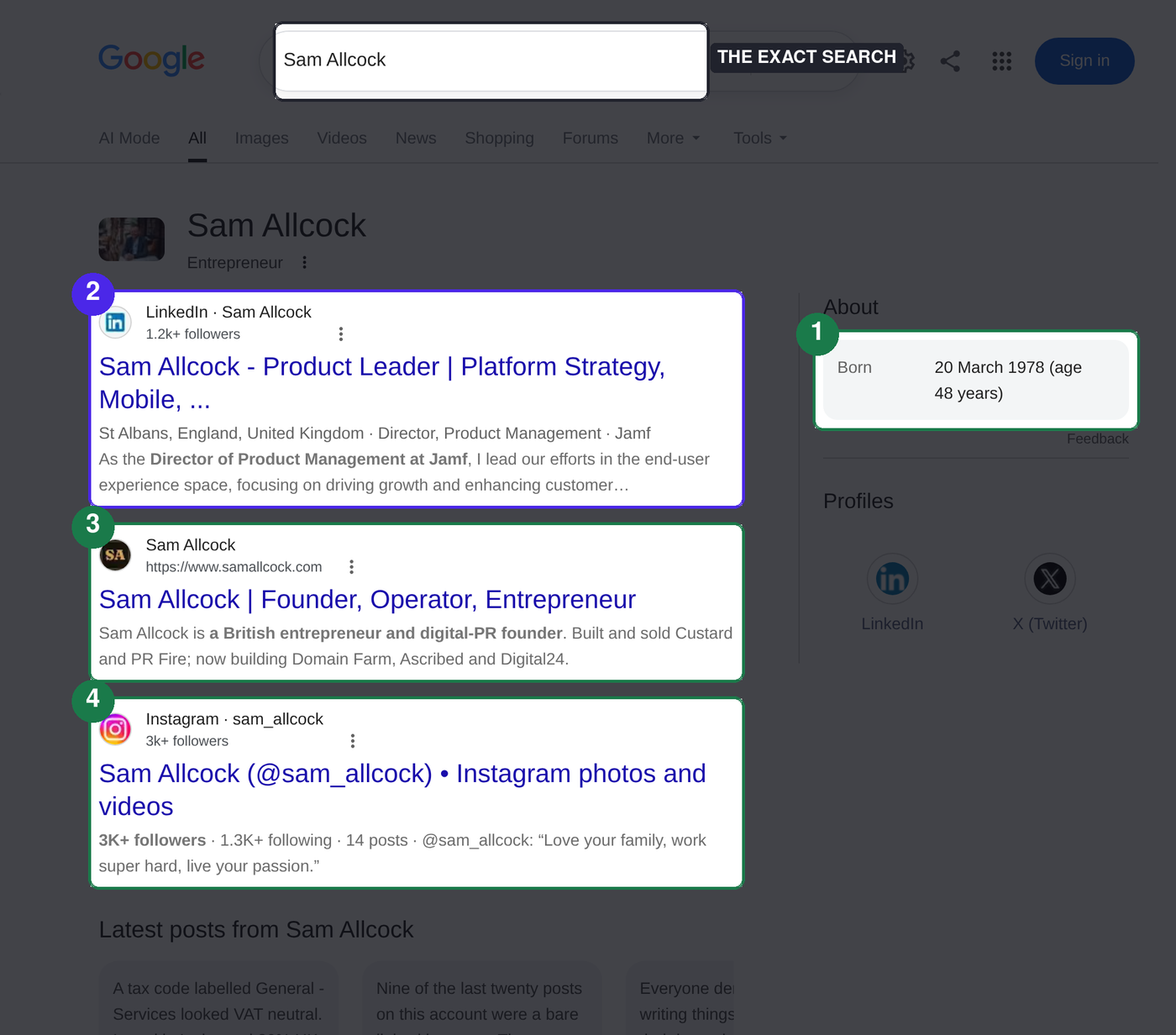
Type your own name into Google while signed out and you get ten or so results. It feels like a page about you. It is not. It is a page about the name, and Google has assembled it from whatever it holds against those words.
Some of those results are yours. Some belong to other people with the same name. And some are things Google cannot confidently attach to anybody, which it shows anyway because they match the words. Three different kinds of result, presented identically, with nothing on the page to tell them apart.
The person reading that page cannot tell either. That is the whole problem, and it is why the first useful thing is not a strategy but a count.
How common this is, we counted
Between August and October 2026 we ran 21 free audits on real people who asked for one. Every audit counts how many of the first page results can be shown to belong to the person, using a strict test described below.
20 of the 21 owned under a fifth of their own first page. One reached 40 per cent and was the only person above a fifth. Nobody came close to owning the page.
20 of 21 people owned under a fifth of their own first page of results. The one exception reached 40 per cent.
These were not anonymous members of the public. They were company directors, partners in law firms, founders and consultants, most of them with a long career and an active profile somewhere. Seniority does not protect you from this. In several cases it made it worse, because a longer career leaves more half-current records behind.
The number is explained properly in how much of your first page is yours, including why it understates ownership rather than overstating it.
The four things usually on the page
Across those audits the same four kinds of result came up again and again:
- Profiles you own and could edit today, usually LinkedIn, sometimes an old company page.
- Other people who share your name, often with a stronger record than yours.
- Directories and registers that hold a version of you, frequently an out of date one.
- Results that cannot confidently be attached to anybody, which look exactly like the first three.
The second one is the one people find hardest to accept and the easiest to measure. One coach we audited shared his name with five other people on his own first page, including a rival in the same trade and a footballer who died in 1970. One woman's name returned a socialite who died in 1939.
Neither of those is a problem you can fix by asking anybody to remove anything. They are other people, with as much right to the name as you. Sharing your name covers what actually works there, and what does not.
Why this happens, and it is not a penalty
People often read a thin first page as a punishment, as though Google has decided against them. It has not. There is no penalty involved and nothing has gone wrong.
A search engine ranks pages it knows about. If the strongest, clearest, most linked page carrying your name belongs to somebody else, that page wins, because on the evidence available it is the better answer to those words. Nothing about that is personal and nothing about it is unfair.
What that means practically is encouraging. The gap is almost always an absence rather than a problem: there is no strong page that is unmistakably yours, so something else fills the space. Absences are far easier to close than penalties.
What actually moves it
The order matters, and it is not the order most people start with. Buying coverage first is the common instinct and it is the expensive one, because coverage that points at nothing clear leaves the same confusion with more pages in it.
The first two steps are free and most people have done neither. Make your job title identical everywhere, word for word, and list your own profiles on your own site so the connections between them are stated rather than guessed at. Ranking for your own name sets out the free steps in order.
After that it is about having one page that is plainly about you and a record that agrees with it. That is the same work that produces a knowledge panel, which is covered in what actually produces a knowledge panel.
What we will not tell you
We cannot get another person's result removed because it shares your name. They are entitled to it. Anybody offering to clear namesakes off your first page is describing something they cannot do.
We also will not put a timescale on a particular position. What we do is aim for a page one that is unmistakably yours, and show you the count before and after so you can see whether it moved.
And some results should not be written about at all. Where a result on somebody's name turns out to be a legal matter belonging to a different person, we say it is not them and we discuss it by telephone rather than putting it in a document that can be forwarded. That rule costs us nothing and protects the person it actually belongs to.
Where to start
Search your own name signed out, on a phone and on a desktop, in the country you care about. Write down how many of the first ten results are actually you. Most people are surprised, and the surprise is the useful part.
That count is the same one our free audit produces, with the working shown and each result attributed or marked as unclear. It takes a few minutes and there is nothing to buy at the end of it.
21 free audits run between August and October 2026. Under a deliberately strict test, 20 of the 21 people could be shown to own under a fifth of their own first page of results. The highest was 40 per cent, and that person was the only one above a fifth.