Know your customer, usually shortened to KYC, is the name for the checks a business runs before it deals with you. The guides that explain it are written for the people doing the checking. This one is written for the person being checked, because you are the one who pays when the check gets you wrong, and you are the only one with any say over what it finds.
What a know your customer check actually is
In the UK the formal version comes from the Money Laundering Regulations 2017. Banks, payment firms, law firms, accountants, estate agents, tax advisers and a long list of others must identify the people they deal with, verify that identity, and understand what the relationship is for. That duty sits in regulation 28. HMRC's guidance calls it customer due diligence and notes that it is often called know your customer. They are the same thing.
The checks come in three strengths, set by how risky the business judges you to be.
Three strengths of check
For people in prominent public positions, the enhanced checks carry on for at least twelve months after they leave office. The FCA's guidance on politically exposed persons sets out who counts. Enhanced checks go further into what has been said about you, and that is where reputation stops being vanity and starts being paperwork.
What a KYC check looks for
Strip away the vendor language and there are three things a screening tool runs your name against, and they behave very differently.
What your name is checked against
Sanctions lists
Official lists of people nobody may deal with. A date of birth usually settles a near match.
Public positions
A status, not a judgement. You either hold that kind of role or you do not.
Negative news
No list. Anything written about anybody with your name. A person decides if it is you.
Sanctions lists
Government lists of people and companies nobody may deal with. The UK's is the UK sanctions list, published by the government. The answer is yes or no. If you are not on one, the only risk is a near match on your name, and a date of birth usually settles it.
Politically exposed persons
People in prominent public positions, plus their relatives and close associates. Again it is a status rather than a judgement.
Adverse media
This is the one that catches ordinary people. Adverse media means negative news: coverage of fraud, court cases, regulatory action, insolvency, disputes. There is no list. Screening tools search news archives and the wider web for your name next to words like fraud, charged, convicted, struck off or liquidation, and a person then reads whatever comes back.
The regulations never say "search the news". Firms do it because the law asks them to understand the risk a customer poses, and reading what has been published about someone is the obvious way to do that. So it is close to universal at the enhanced end, and common well below it.
Why the person with your name is the problem
A sanctions list carries dates of birth and nationalities. A news article usually carries a name and not much else. So matching your name against the news is loose by nature, and the screening industry says so openly: negative news throws up far more false matches than any list check, and common names are the worst case.
A false match is an article about somebody else that lands on your file. Whoever reviews it has to decide whether it is you, and they decide using what they can find. Here is how that usually plays out.
How a false match travels
Your record is clear
Your own page comes up first, with your company, your city and your field. The article is plainly someone else. Cleared, often the same day.
Your record is thin
Four strangers and an old profile. Nothing to tell you apart. Escalated, a request for more documents, or a quiet no.
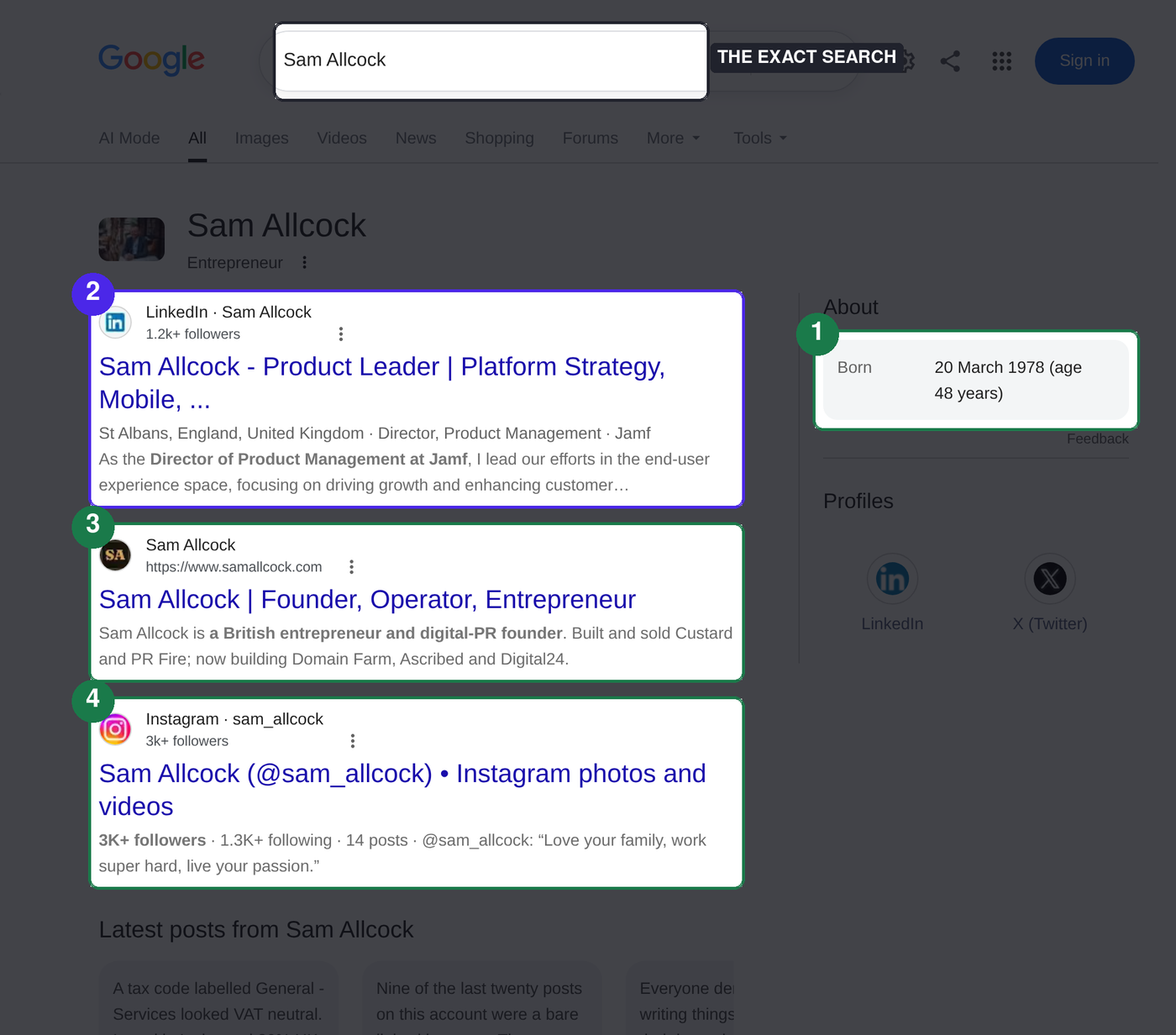
We see how thin it usually is every time we run an audit. Across 21 people we audited in August and September, 20 owned less than a fifth of the first page of Google for their own name.
A typical first page for a person's own name
The rest belonged to strangers, old pages, or results nobody could confidently say were theirs. In one audit, a result on the subject's first page named a different man with the same name as a defendant in a magistrates' court case. Nothing about it was untrue. It just was not our client, and nothing on that page said so.
It happens at every level. Even our founder, who has a knowledge panel, is outranked on his own name by somebody else.
The checks nobody calls KYC
The formal checks are a small share of the times you get looked up. Plenty of people do their own version with no regulation involved and no screening tool, just a search box.
Who checks you
Formal, written into law
BanksPayment firmsLaw firmsAccountantsEstate agentsTax advisers
They tell you a check is happening, and ask for documents when something comes up.
Informal, just a search
InvestorsBuyersClientsBoardsJournalistsLandlordsAI assistants
They never tell you. You see the result as silence.
- Investors check founders before they commit. The established funds pay firms to do it properly, covering court records, credentials and online reputation. Angels tend to rely on their networks and their own searching.
- Buyers and acquirers check the directors of a business they are about to pay for.
- Prospective clients check the adviser, solicitor or consultant before the first call.
- Employers and boards check senior hires and non executive appointments.
- Journalists check anybody they are about to quote.
- Landlords and agents check tenants on larger lets.
More and more of this now happens in an AI assistant rather than a search engine. Somebody asks ChatGPT or Gemini who you are and reads the paragraph it writes. Those answers are built from the same published sources, and when the sources are thin, the assistant fills the gap with whoever it can find. We asked four assistants about one company whose name starts with an ordinary English word.
Four assistants asked about one company, September 2026
None of these people will tell you what they found. A formal check at least produces a request you can answer. An informal one produces silence: the meeting that does not get booked, the investor who goes quiet, the client who picks somebody else.
What a false match costs you
Most of the time, nothing dramatic. The cost is friction, and it is hard to see because nobody explains it:
- Delay. An account opening, a mortgage, a property purchase or a fund admission takes weeks longer because a hit needs clearing.
- More paperwork. Requests for source of funds, bank statements, explanations of things that were never about you.
- Enhanced checks you did not need. A file marked higher risk stays higher risk, and gets reviewed again.
- A closed door with no reason given. Banks are generally not obliged to tell you why they close an account. Decisions published by the Financial Ombudsman Service show that where the bank gave notice and its terms allowed it, the closure usually stands.
- Lost business. The informal checks, which cost you without ever telling you they happened.
The common thread is that you rarely see the result that caused it. You see the consequence.
What you can control, and what you cannot
It is worth being plain about the limits first, because a lot of what is sold in this space ignores them.
Out of your hands
- Sanctions and public position lists
- Court records
- The Companies House register
- Accurate reporting about you
- Other people who share your name
Yours to shape
- Your details agreeing everywhere
- Details that tell you apart
- A page clearly about you
- Old profiles you published
- Real coverage of what you do
- A Google knowledge panel
What you cannot change
- A sanctions list, a register of people in public positions, or a court record. These are official and they stay.
- Companies House. Your appointments, your resignations and any company that was dissolved stay on the public register.
- Accurate reporting about you. If the story is genuinely yours, the honest routes to dealing with it are narrow, and some cannot be done at all.
- Articles about other people with your name. They are somebody else's record, and they have every right to be there.
What you can control
What you can do is make it easy for anybody checking to tell you apart from everybody else, and to land on your version first. That is the whole job, and it is more than most people realise.
- Your own details agreeing everywhere. The same name, the same title, the same company, the same city on your website, LinkedIn, company profiles and directory listings. We regularly find one person described with three job titles and two firm names across four sources. Each disagreement makes you look like more than one person. See when your details disagree.
- Details that separate you from a namesake. Your company and its registered number, your location, your field, and where it is appropriate your year of birth. These are exactly what a reviewer reaches for.
Two people, one name. What a reviewer compares
| The one in the article | You | |
|---|---|---|
| Name | Daniel Reeve | Daniel Reeve |
| Company | Not stated | His company, named, with its registered number |
| Where | Leeds | Manchester |
| Field | Building trade | Corporate finance |
| Year of birth | Not stated | 1981 |
- A page that is clearly about you. A page in your own name that states who you are and links to your real profiles, so that one search lands on the right person and everything else points back to it. Search engines read small hidden labels that say a page is about a particular person, with their name and job, and most people's sites have none. See how to rank for your own name.
- Old information you published yourself. Stale profiles, old titles and dead company pages you control can be corrected or closed.
- Real coverage of what you actually do. One genuine article in a real publication gives a reviewer something independent to read, and gives the assistants something to cite that is about you.
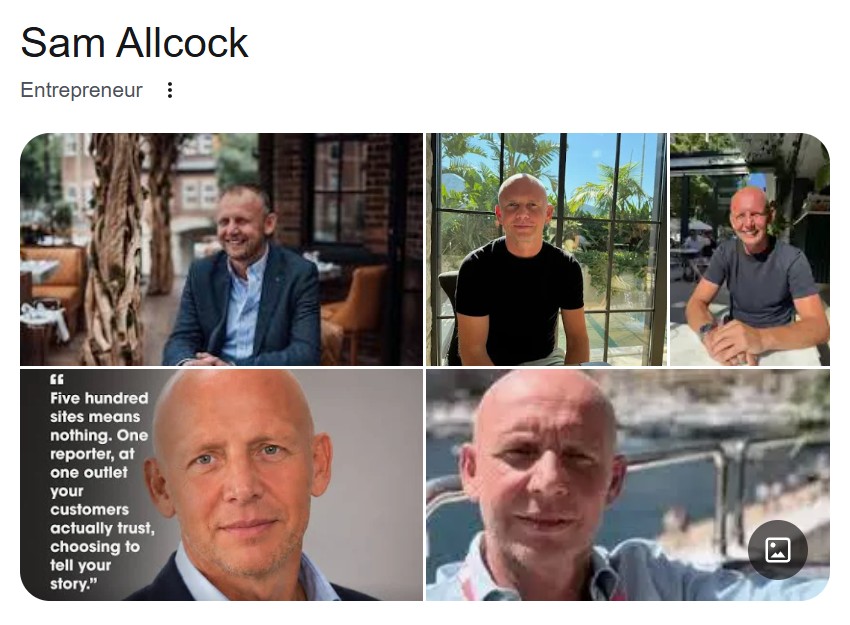
- A Google knowledge panel. The box on the right of the results that states who somebody is. When one exists for you, it is the first thing a checker sees. We aim to get clients one, because it is the clearest possible signal that a name belongs to a specific person. Google explains how the owner of a panel can get verified; ours explains how panels appear.
How to check yourself the way a screener would
You can run most of this in half an hour. Do it signed out of Google, or in a private window, so you see what a stranger sees.
The searches to run
- Search your name the way people actually type it. Your full name on its own, then with your company, your job title and your city. Not the clever phrase that flatters the answer. The bare name is usually the honest one.
- Go through the first page result by result. For each one, ask: is this me, is it somebody else, or could a stranger not tell? Count how many are clearly you.
- Search your name next to the words a screener uses. Fraud, court, charged, convicted, struck off, liquidation, disqualified. Uncomfortable, but this is what the tools run. If something comes up for a namesake, note what would let a reader tell you apart.
- Check the News tab and Images. Pictures of somebody else under your name are common and confusing.
- Look yourself up on Companies House. Check every appointment is right, and look for any dissolved company under your name or one like it.
- Ask the AI assistants. Ask ChatGPT, Gemini, Perplexity and Claude who you are, and look at which sources they cite. Our guide on checking what AI says about you walks through it.
- Write down where your details disagree. Titles, company names, dates, locations. Every mismatch is a reason for a reviewer to hesitate.
If your search turns up your home address or phone number, Google has a tool to find and request removal of personal contact details from its results.
Our free audit runs these searches for you, photographs your first page in your own country, and asks you to tell us which results are yours, so the report is built on your reading rather than our guess. Not sure which situation you are in? Where do you stand sorts it into five.
Know your business: the company version
Firms check companies as well as people, often called know your business. It starts with the public register and follows the people behind the company. Three things we find again and again:
- A dead company ranking for a live firm's name. In one audit the register result for a law firm's short name was a partnership dissolved in 2023. The company that actually trades was not on the first page at all. See a dissolved company on page one.
- The wrong company number in circulation. One business gave us a number that, on the register, belonged to an unrelated company dissolved years earlier. See the wrong company number.
- Links through a director. The register publishes who runs which company, both ways. If a director has a troubled company in their past, a new company they run inherits the association in one step. Building up the founder's own profile can make this worse, because it strengthens the link. See when a director links two companies.
The company side has its own guide, your company in search, and its own service, for businesses.
When the result is genuinely yours
Sometimes the article a screener finds is about you. An old dispute, a failed business, a case you were involved in. Pretending otherwise does not work, and a checker who finds you hiding it trusts you less than one who finds it explained.
Two things help. First, context: a clear, current record of who you are and what you do now, so the old story is one result among many rather than the whole picture. Second, accuracy: if what is published is wrong, out of date or about a matter since settled in your favour, there may be a route to correcting or removing it. UK data protection law gives you a right to ask for personal data to be deleted in some circumstances, though not where the reporting is accurate and in the public interest. Anything with a legal side is a conversation rather than a form. Where removal is the goal, the first step is showing exactly which results are yours, which is the same groundwork as everything above.
The short version
Every serious decision someone makes about you now starts with a search. The formal checks are written into law, the informal ones are just habit, and both read whatever has been published under your name. You cannot choose what is on the official lists, and you cannot remove other people who share your name. You can make sure that when somebody looks, the first thing they find is clearly you, says the same thing everywhere, and gives them enough to tell you apart.
Questions people ask
Is KYC the same as customer due diligence?
Yes. In the UK the formal term is customer due diligence and HMRC notes it is often called know your customer. Enhanced due diligence is the stronger version used for higher risk situations.
Do KYC checks search Google?
The formal screening tools search news archives and the wider web for negative coverage, which the industry calls adverse media. When a tool flags something, a person reviews it, and an ordinary search of your name is the quickest way for them to look. The informal checks, by investors, clients and employers, are usually just a search.
Can a namesake make me fail a KYC check?
A namesake's coverage can be flagged against you. A reviewer should clear it once they can tell you apart, usually with your date of birth, address or company. The thinner your own published record, the harder that is and the longer it takes.
Will a bank tell me why it closed my account?
Usually not. Banks are generally not obliged to give reasons. If you think the closure was unfair, you can complain to the bank and then to the Financial Ombudsman Service, which looks at whether the bank followed its terms and gave proper notice.
Can I get negative articles about me removed?
Sometimes, and only in particular circumstances. Accurate reporting in the public interest usually stays. Inaccurate, outdated or unlawful material may have a route. Our audit separates what is yours from what is somebody else's first, because nothing can be removed until that is clear.
Sources
- GOV.UK, Money Laundering Regulations: your responsibilities
- MLR 2017 regulation 28, regulation 33, regulation 35
- HMRC, anti-money laundering guidance for supervised businesses
- FCA FG25/3, the treatment of politically exposed persons
- GOV.UK, the UK sanctions list
- LSEG, adverse media screening
- Financial Ombudsman Service
- Companies House
- Google, find and remove personal info in Search; Google, get verified on a knowledge panel
- ICO, your right to get your data deleted
Ascribed figures come from our own audits (August and September 2026) and AI citation readings (September 2026). No client is named.