Almost 40% of what AI assistants say about a UK solicitor comes from that solicitor’s own website
Independent journalism accounts for 2.6%. Nearly a quarter of the pages the assistants put forward as their sources never mention the person at all. A new study checked all 12,355 sources cited about 98 named solicitors on the public register.
Ascribed, which builds and maintains the public record of senior professionals, asked four AI assistants three questions each about 98 solicitors named on the Solicitors Regulation Authority’s public register: who the person is, whether they are credible, and what they are associated with. That produced 1,176 answers and 12,355 citations. Every cited address was then fetched and checked on 12 November 2026.
The finding is not that the assistants struggle to identify people. They are good at it. 1,171 of the 1,176 answers, or 99.6%, named the right person. The finding is what they are reading in order to do it.
Four assistants, three questions each, 12 November 2026. Percentages of sources are of the 6,666 citations that name a readable website.
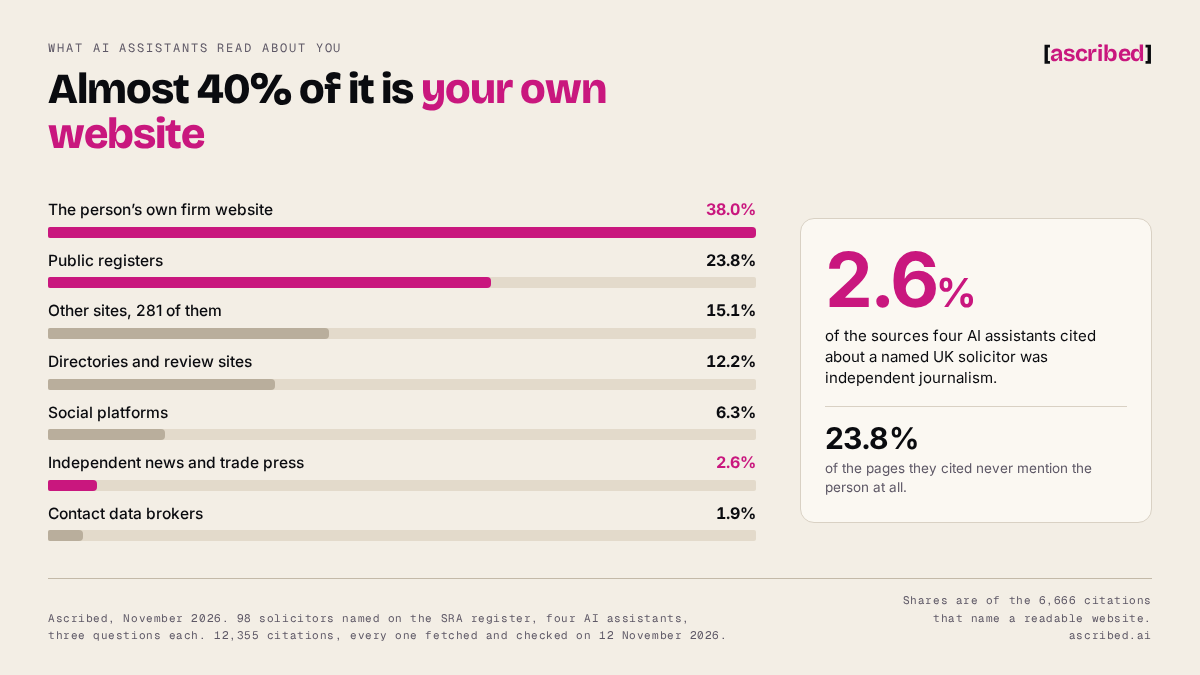
What the assistants actually read
Of the 12,355 citations, 6,666 pointed at a website that can be named. The remaining 5,689 were all Gemini’s, and are covered separately below. Ranked by share, this is where the other three assistants went.
Bars are scaled to the largest share, and every row carries its own citation count. Hosts were sorted into these groups by hand, after reading them; anything not recognised stayed in Other rather than being pushed into a group to tidy the total. There is a longer account of where assistants get their answers.
So roughly 62% of the sourcing is the firm’s own marketing and the statutory register. Those are the two places a professional either writes themselves or has filled in for them by law. What an independent journalist has written about them is 2.6%.
The pattern is not one assistant’s quirk. The three that cite directly agree closely, which is the part worth noticing.
| Source | ChatGPT | Claude | Perplexity |
|---|---|---|---|
| Own firm website | 36.9% | 37.1% | 39.3% |
| Public registers | 24.7% | 17.5% | 28.8% |
| Directories, reviews | 12.8% | 15.8% | 9.0% |
| Social platforms | 6.0% | 5.7% | 6.8% |
| News, trade press | 1.7% | 2.0% | 3.6% |
| Contact data brokers | 0.6% | 3.5% | 1.2% |
| Other | 17.4% | 18.4% | 11.4% |
| Citations counted | 1,268 | 2,458 | 2,940 |
A quarter of the sources are about the firm, not the person
Of the cited pages that could be read a second time, 542 of 2,102, or 25.8%, never print the person’s surname anywhere. Reading them shows what they mostly are: the firm’s entry on the regulator’s register, the firm’s review page, the firm’s profile in a legal directory, the firm’s page about a practice area.
That is not invention, and it should not be reported as invention. An assistant may legitimately cite a firm’s page to establish that the firm exists and is regulated. It is thin sourcing rather than false sourcing. The practical consequence is the same either way: when an assistant is asked who somebody is, a quarter of what it offers as evidence is a document that does not mention them. Ascribed keeps a plain-English guide to what AI assistants say about you and how to check it.
What we looked for and did not find
The study set out to test a widely repeated claim, that AI assistants invent sources. On this sample, at this scale, it did not happen, and that deserves saying as plainly as the rest.
Across 574 different websites, every one was checked for a domain record and for any history in the Internet Archive. An address counts as invented only if it has neither. Not one of the 574 met that test.
Ten had no working address on the day of the check. Eight of the ten have snapshots in the Internet Archive, so they were plainly real sites once: a firm that closed, a conference page taken down, a domain that lapsed. The other two sit on domains that are still registered but have no archive history, so the honest answer for those two is that we cannot tell what they were.
What does happen is decay. 2.9% of citations pointed at something that could not be reached, either a website that no longer answers or a page returning an error. 40 of the 98 people had at least one source that has gone. A further 11.9% of pages could not be checked at all, because the site refused an automated request. Those are reported as unchecked, never as missing.
Two firms, one name, two continents
The clearest single error in the study
One subject is a solicitor at a small English firm named after its founder. A law firm in California happens to be named after a man with the same name, and holds the matching .com address while the English firm holds the .co.uk.
Asked about the English solicitor, one assistant cited the Californian firm eight times: its press releases, its anniversary page, and a page about a regional award in Southern California. It also cited the staff page of an unrelated international firm, and a Canadian provincial regulator’s directory. The other three assistants stayed on the correct firm throughout.
Neither firm nor either individual is named here. They are identifiable from public records, and neither agreed to appear in a study, so naming them would make a private professional the illustration of somebody else’s defect.
This is the ordinary case rather than a freak one. A name is not an identity, and an assistant assembling a description from whatever carries the right words will sometimes assemble the wrong person. The same thing happens to companies, where an assistant answers about a different firm with a similar name, and to individuals who share a name with somebody better documented.
One assistant’s sources cannot be read directly
Every one of Gemini’s 5,689 citations was a Google redirect rather than a link to the source, so none of them names a publisher until it is followed. The other three assistants returned direct links in every case. All 2,039 distinct redirects were followed successfully for this study, and they led to real pages, so this is a question of transparency rather than accuracy: the sources are there, and seeing what they are takes two thousand extra requests. The four assistants also disagree with each other about the same person on the same day.
Method
Published in full so the work can be repeated or disputed.
- Subjects. 98 people named on the Solicitors Regulation Authority’s public register, each with a role and a firm. 100 were drawn; two were discarded before analysis because the name field held a phrase rather than a person, which is a fault in our reading of the register.
- Questions. Three per assistant: who the person is, whether they are credible, what they are associated with. The firm name was supplied in the question, so whether an answer repeats the firm correctly proves nothing and is not reported.
- Assistants. Reached through DataForSEO’s AI Optimization API on 12 November 2026, using each provider’s web search model: ChatGPT (gpt-5-mini), Gemini (gemini-3.8-flash), Perplexity (sonar) and Claude (claude-sonnet-5).
- Citations. Taken from the structure each provider returns, not parsed out of the prose. Counted as given, including repeats, because a source cited four times in one answer was offered four times.
- Checking. Every distinct address fetched. Three outcomes were recorded and kept separate: reachable, gone, or could not be checked. A refusal, a rate limit or a timeout is never counted as a dead source.
- Naming. A page counts as naming the person if both the first name and surname appear. Accents and middle names are allowed for, because an exact match on the register’s spelling reports correct pages as failures. That error was made during this study and corrected: it had doubled one figure and inflated another twentyfold before the matcher was tested against known cases.
- Cost. $32.66 in total, about 33 cents a person.
What this study does not show
- It is one day. Assistants change their answers; a repeat next month would not be identical.
- It tests the web search model of each assistant through its API, which is not the same as the consumer app and not the largest model each provider offers. Results may differ there.
- It covers UK solicitors, a profession with an unusually good public register. A trade with no register would look different, probably worse.
- 11.9% of pages could not be checked because sites refused an automated request. That is a real limit on the reachability figures and is reported rather than estimated away.
- “Does not name the person” is not a measure of inaccuracy. Citing a firm’s page about a person at that firm can be perfectly reasonable.
Notes to editors
The underlying data is available to journalists on request, including every question, every answer, every citation and the result of every check, so any figure here can be recounted independently.
No individual solicitor is named in this release. The subjects were drawn from a public register and none agreed to take part in a study, so the findings are reported as patterns. The same applies to the firms.
Ascribed builds and maintains the public record of senior professionals so that search engines and AI assistants describe them from sources that are accurate and checked. Its free guides on your name in search are at ascribed.ai/learn, and it offers a free audit that runs the same checks used in this study on one person. It is a trading name of Domain Farm Ltd.
Contact. hello@ascribed.ai · ascribed.ai
Domain Farm Ltd, company 13544286, registered in England and Wales.
Vantage House, Euxton Lane, Euxton, Chorley, Lancashire, PR7 6TB.
VAT GB435224124.