Case study · Knowledge panel

No entity to a panel in eleven days.

Mark Creaser had three decades of public record and no knowledge panel. We built the entity layer underneath it. The panel appeared on 14 August 2026, with the subtitle he asked for.

11
Days to panel
1
Wikidata item
6
Linked schema nodes
0
Links bought
01

The brief, in his words

A knowledge panel for his name, showing his photograph, with the word Entrepreneur beside it.

All three were specific and testable, which is the right way to be given a brief. Two are delivered. The third is delivered in part, and the remaining fix is set out at the end of this page rather than quietly left out.

02

Before and after

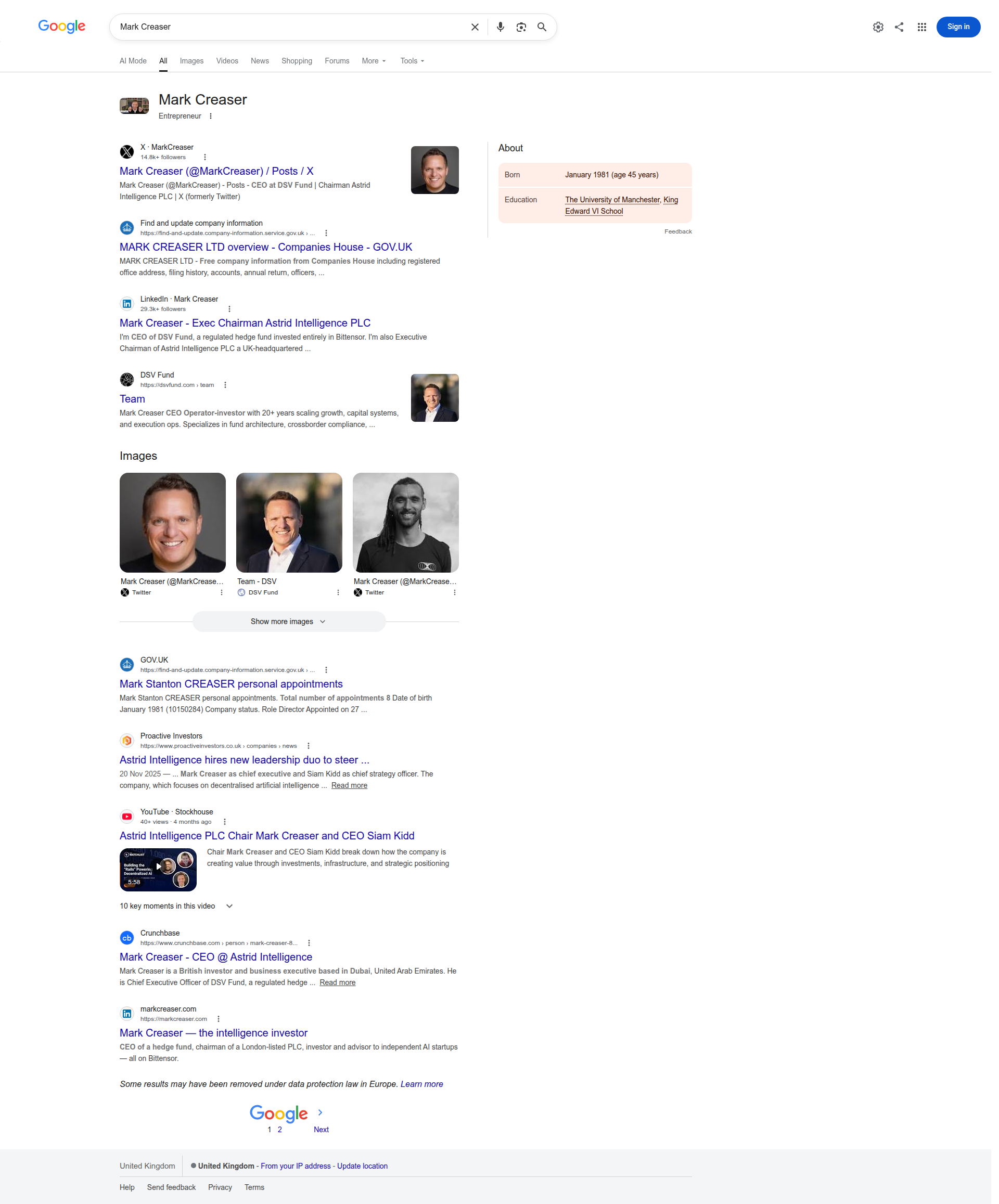
Both captured the same way, from the same query, one day apart.

Before13 August 2026
Google results for Mark Creaser on 13 August 2026, no knowledge panel
Results begin at the top left. The right hand column is empty.
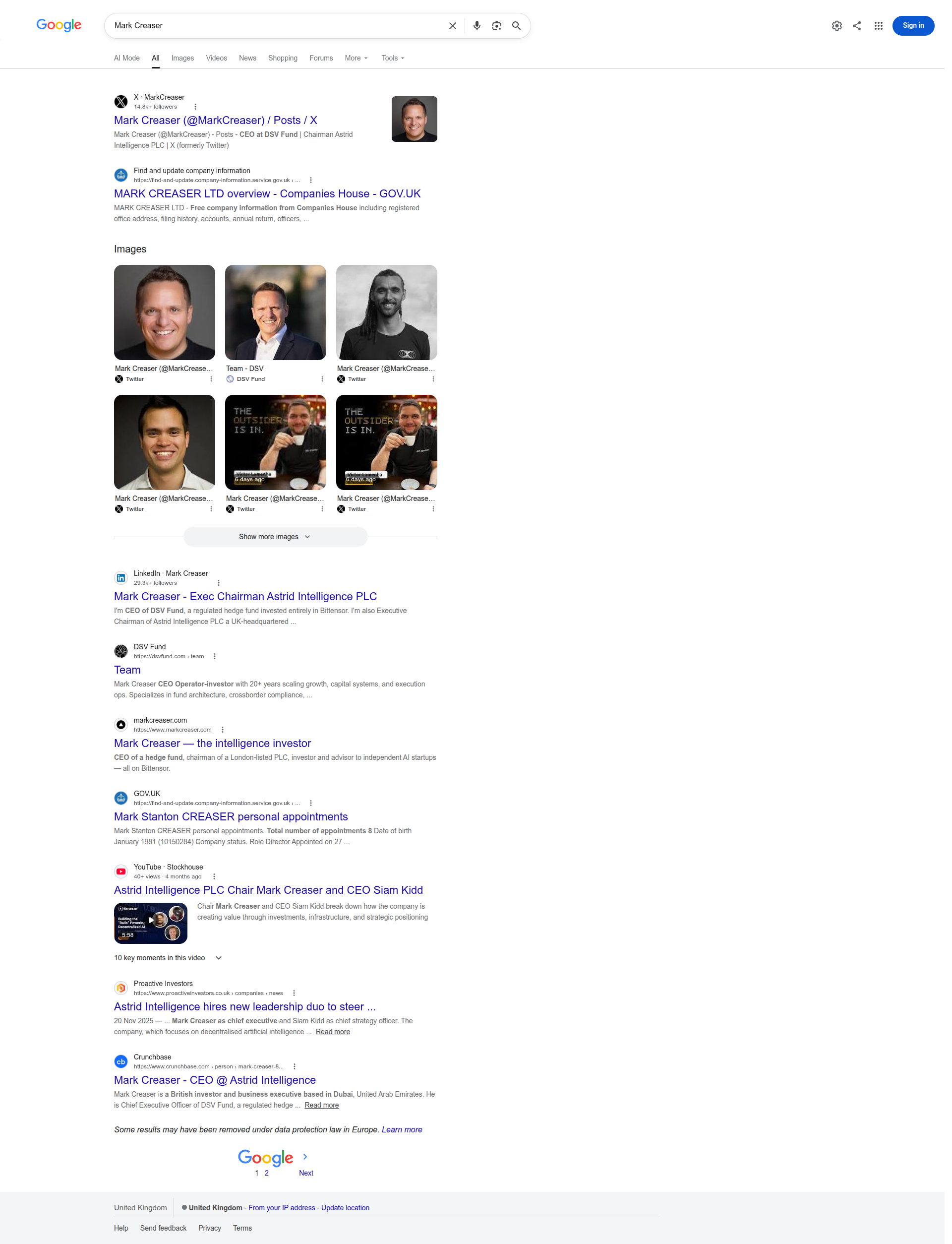
After14 August 2026
Google results for Mark Creaser on 14 August 2026, knowledge panel present
His name and Entrepreneur now head the page, with an About card carrying his year of birth and education.

Click either capture to open the full page screenshot it was cropped from.

03

The starting point

He was not an unknown. That is the point of this case.

What already existed

  • Chief Executive of a regulated fund, Executive Chairman of a London listed PLC
  • Companies House records, including his own named company
  • Regulatory announcements carried by Aquis, Investegate, Nasdaq and Proactive Investors
  • An X account with 14,800 followers, LinkedIn with 29,300
  • A personal website ranking seventh for his own name

What did not

  • No knowledge panel
  • No Wikidata record
  • No structured data on his own website
  • No agreed job title. Different sources called him CEO, Chairman and Executive Chairman
  • Nothing called him an entrepreneur, the one word he wanted
Why the panel had not formed. Every fact Google needed was already published somewhere. What was missing was anything stating that the person on Companies House, the person on the fund's team page and the person on X were one individual. Google will not make that leap on inference alone, and it had nothing structured to read. So the work was not to create attention. It was to remove ambiguity.
04

What we built

In order of contribution, heaviest first.

01

The Wikidata item

A structured record stating who he is, what he does and which accounts belong to him, each statement carrying a real reference. Created as Q140980510.

02

Structured data on his own site

One JSON-LD block describing six linked nodes: him, the two companies, the advisory, the site and his profile page, with a sameAs list pointing at every account and register entry. His website stopped being a page about him and became a machine readable statement of identity.

03

One job title, everywhere

Executive Chairman, effective 4 March 2026, evidenced by the regulatory announcement. Rolled out across every profile so the sources stopped contradicting each other.

04

An encyclopaedic profile and aligned accounts

A referenced profile carrying six citations, and every social and directory account brought onto the same name, title and description.

What we did not do. No links were bought and no press was placed for this result. The entire programme was structured data, identity consistency and referencing. For a knowledge panel, corroboration is the currency. Link volume is close to irrelevant, and a manufactured looking footprint actively works against you.
Attribution

How we know what caused it

Panels appear on Google's schedule, so it is fair to ask whether this one would have arrived anyway. In this case the panel itself answers the question.

The About card displays two facts: born January 1981, and educated at the University of Manchester and King Edward VI School. His month of birth appears in exactly one place on the open web in a form a machine can read: the Wikidata item we created. The education statement is the same. Google is not inferring these from press coverage, because the press coverage does not contain them.

The panel is reading our record. That is as close to a controlled result as this discipline allows.
05

Timeline

DateEvent
3 AugustBaseline captured. No panel, no entity record
To 12 AugustWikidata item, site schema, title alignment, profile consistency
13 AugustStructured data verified live. Still no panel
14 AugustPanel present, subtitle Entrepreneur
06

What is finished, and what is not

The briefStatus
A knowledge panel for his nameDelivered. Live 14 August 2026
Entrepreneur beside his nameDelivered. Exactly as briefed
His photograph in the panelPartly. An image is showing, but not the right one
The outstanding item, stated plainly. Google has chosen a still frame from a video interview rather than his portrait. The cause is identifiable: the Wikidata item carries no image property, so with no licensed image attached to the entity, Google used what it could find. The fix is to license one of his own photographs, upload it to Wikimedia Commons and attach it to the item. Because he took the photographs himself, the copyright is clean and the licence is his to give. That is a matter of days, not another programme of work.
What this is evidence of

And, just as importantly, what it is not

It shows

  • A panel follows entity confidence, and that confidence can be built deliberately
  • The timescale is weeks, not years, where a genuine public record already exists
  • The heavy lifting is structured data and consistency, not coverage volume

It does not show

  • That a panel can be promised. Google decides, and we never promise one
  • That this works without a record. Where a subject has none, none of it applies
  • That the method invents an entity. It makes an existing one legible